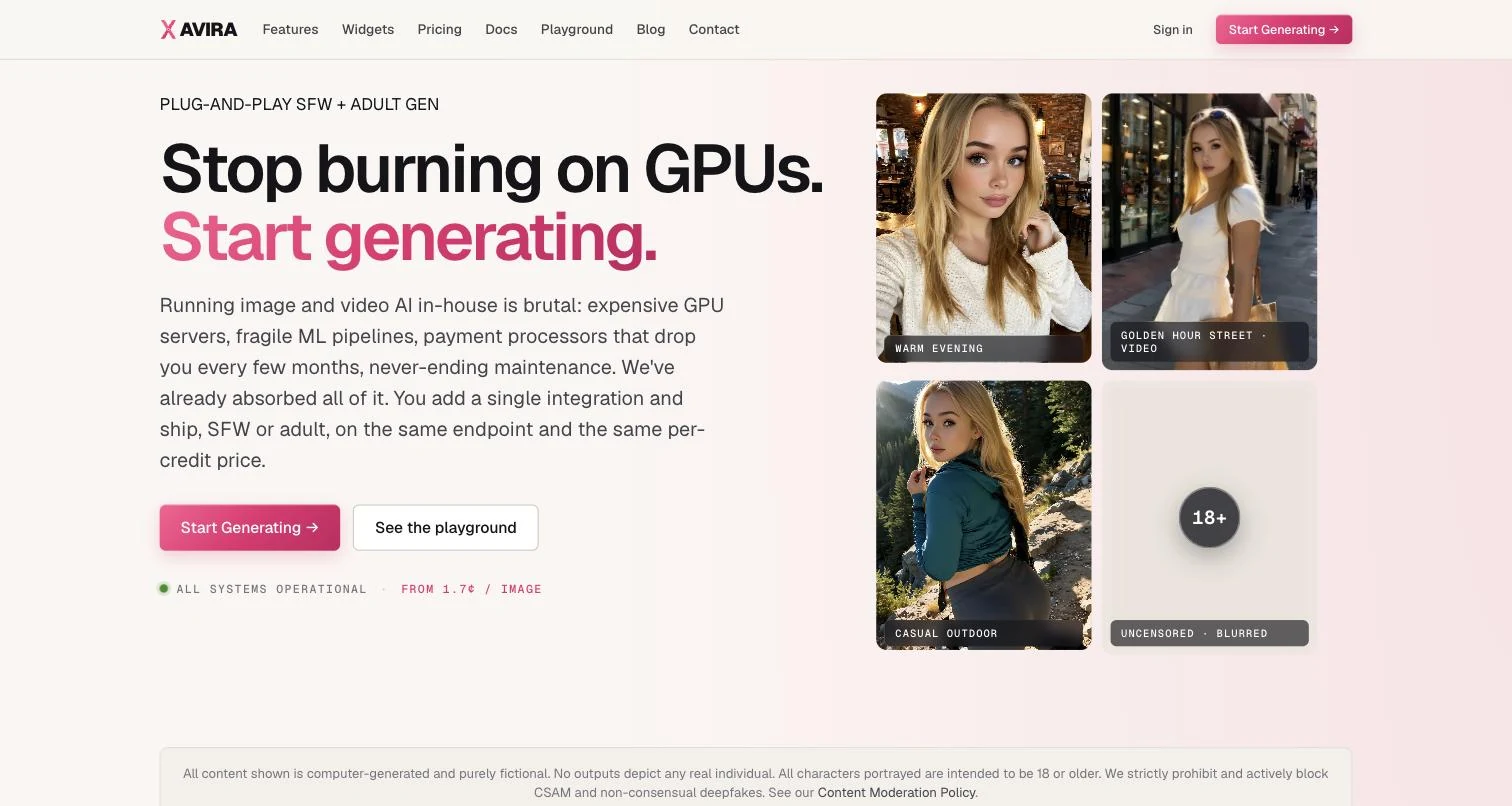
Every adult product hits the same wall eventually. You want image generation that is actually good, that stays uncensored, and that does not fall over on a Friday night. Then you find out what it takes to run that yourself.
We have been on both sides of that wall. So when people ask us which AI porn API we would point them at, the honest answer is the one we use: Xavira.
What we can offer that most reviews cannot is both sides of the problem. We have run an adult consumer product at real volume and we have run the generation behind it, so we know precisely which parts of this are hard and which parts only look hard.
What an AI porn generator API actually has to do
The demos make this look easy. Text goes in, picture comes out. The reality of shipping an adult product on top of that is a much longer list.
Your characters have to stay the same person across hundreds of images. A generic porn API that returns a beautiful stranger every call is useless the moment your users get attached to someone. Xavira treats the character as a first-class object: you create her once, you get an id back, and every generation after that renders the same face. That single design decision removes an enormous amount of work on your side.
Then there is the part nobody puts in a landing page. Content moderation that is strict where it has to be and permissive everywhere else. Storage that does not expire your customers images out from under them. Webhooks that retry. Idempotency, so a network blip does not double charge someone. Payment rails that will actually process adult transactions. None of that is glamorous and all of it is required.
The part people underestimate: renting GPUs yourself
This is where we can speak from scar tissue rather than theory.
Renting capacity looks cheap on the spreadsheet. You compare an hourly rate against a per image price, the hourly rate wins, and you conclude that building it yourself is the smart move. That comparison is wrong, and it is wrong in a specific way: it prices the compute and ignores the operating.
What the spreadsheet leaves out, in our experience, is roughly this. Capacity that is idle most of the day and saturated for three hours in the evening, so you either overpay constantly or you make people wait. Cold starts that turn a five second generation into a ninety second one. Dependency versions that quietly stop matching and take a whole feature down until someone notices. Health checks that report green while looking at the wrong thing. Storage bills that grow forever because nothing is ever deleted. And a person, permanently, whose job is to care about all of it.
That last one is the real number. The compute is the small part of the bill. The engineer keeping the compute honest is the large part, and they are not doing the thing that makes your product different while they are doing it.
Xavira sells the finished version of that work. You send a request, you get an image, and the entire operational layer is somebody else's problem. At the volumes most products are actually at, it is not close.
What we put through it
This was not a spec sheet read. We used the API the way a customer would: created characters, generated across the pose set with outfits and real backgrounds, pushed stills into video, and deliberately tried the combinations that usually break things. Outfits on two person scenes. Tight crops. Poses where the framing fights the act.
Most of it came back right the first time. One pose we wanted was not in the set at all, and when we looked into why, the answer was that it had been measured, found unreliable with an outfit, and pulled rather than shipped. We tested that ourselves and got the same result they did. Hearing "we removed it because it was a coin flip" is a much better sign than finding out the hard way in front of your users.
What we did not hit is the failure mode that actually costs you a weekend: silence. Jobs that never finish, errors that say nothing useful, credits that disappear without a generation to show for them. Requests either completed or failed with a reason.
What it costs
Prepaid credit packs, and the per image rate falls as the pack gets larger. The important comparison is not against another API, it is against a single worker sitting idle overnight so that your evening peak does not queue. Against that, the per image price stops looking like the expensive option very quickly.
What we liked
Character consistency that holds. This is the feature everything else depends on and it does what it says. The same character, months apart, still looks like herself.
A pose library with opinions. There is a named set of poses rather than a promise that free text will figure it out. More interesting to us: poses that did not hold up got removed instead of shipped at coin flip quality. We would rather have a shorter list that works than a longer list where a third of the results are unusable.
Prepaid credits, no subscription. You buy a pack, you spend it when you want, and there is no monthly minimum quietly draining while you build. For anyone in the phase between prototype and traction, that matters more than the per image rate.
It is built for adult from the start. Not a general purpose image API with the safety rails loosened. That difference shows up in the prompt handling, in the moderation policy, and in the fact that the payment side was designed for this category rather than bolted on.
Where it is not perfect
Two honest caveats.
The pose set is curated, which is the same sentence as the compliment above read from the other side. If you want something outside it you are writing your own prompt, and you are then responsible for the composition yourself.
And it is a two step API. You create a character, then you generate against it. That is the right design for consistency, but it does mean the very first integration takes slightly longer than a single endpoint that just returns a picture. Plan for it and it is a non issue. Discover it at midnight and it is annoying.
Who this is for
If you are building an adult product and generation is a feature rather than your entire company, an AI porn generator API is almost certainly the right call. You get to spend your time on the thing your users actually came for, which is very rarely the render pipeline.
If generation is your whole company and you have the volume to keep hardware busy around the clock, the maths eventually turns. Very few products are there, and most of the ones that think they are have not counted the engineer.
We use it and we would recommend it. You can look at Xavira and decide for yourself.